
Beyond the Divide: What Art in the Age of AI Actually Asks of Us
There is a lot of noise right now about what counts as "real" art in the age of AI and digitalization — and, by extension, who counts as a "real" artist. I don't think the answer is to pick a side. I think the answer is to keep talking.
Art has always been shaped by its socio-economic and cultural environment
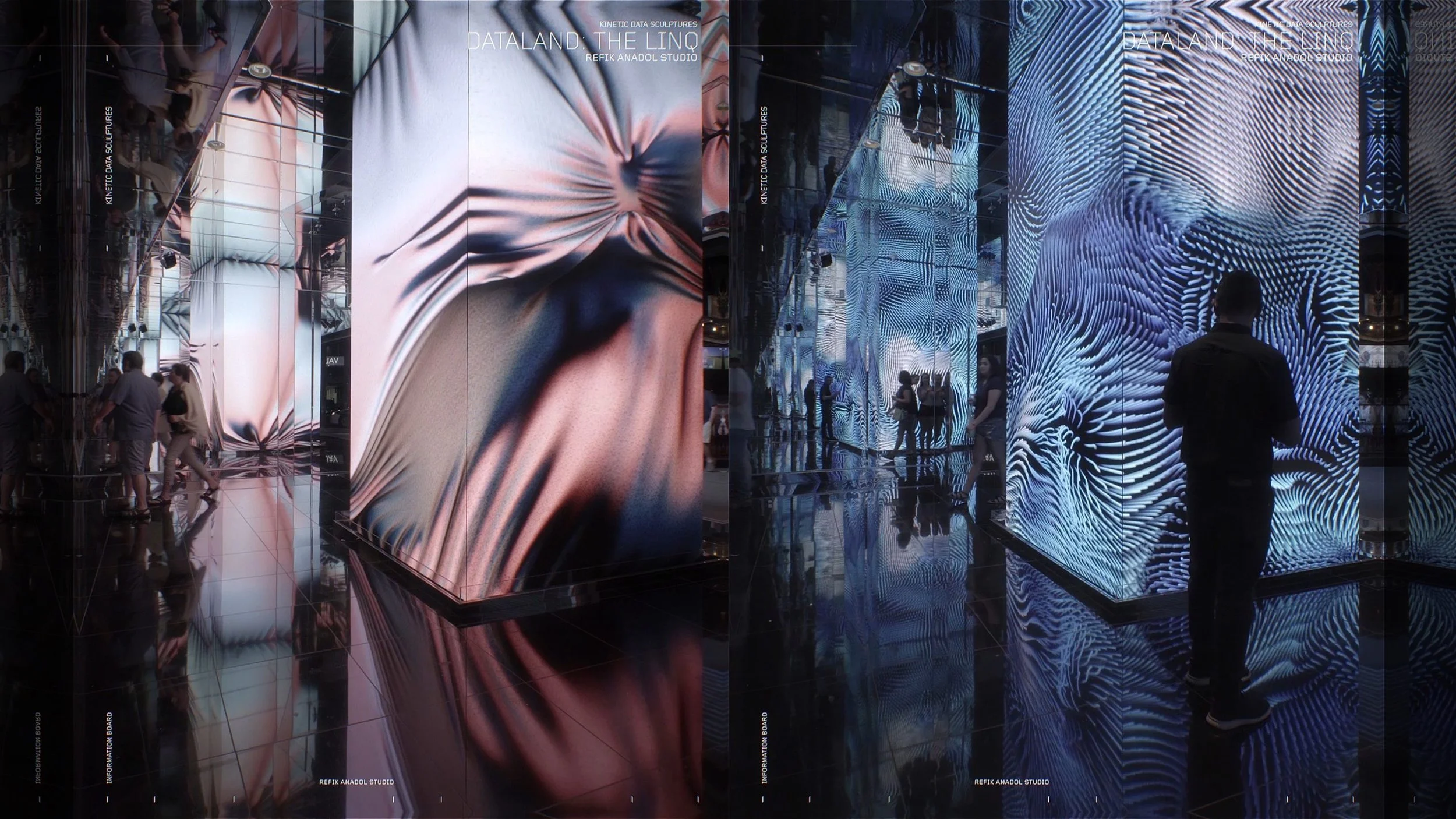
Art more often than not reflects, challenges, or reimagines the world it was made in. So it's not surprising that a data-driven society would produce data-driven art. One of the initiatives that interests me right now is DATALAND in Los Angeles — the first museum built entirely around AI-generated art, founded by Refik Anadol and Efsun Erkılıç.
Through long-term partnerships with institutions like the Smithsonian National Museum of Natural History and other scientific and environmental organizations, the founders built an archive drawing on billions of ecological data points and environmental recordings. But this isn't a static data dashboard dressed up as art. Live algorithms, scent, and sound come together so that each visit produces a genuinely different experience — the installation reworks its own sense of the forest, its flora, fauna, and fungi, in real time. Visitors aren't just looking; they're invited to understand how the systems work and to take part in shaping the conversation about where this goes next.
As the founder of The Art of Change, I'm drawn to something else about DATALAND too: it exists because of partnerships — with museums, universities, and corporations including Google and Nvidia. That's precisely the model at the heart of The Art of Change: artists, the corporate world, and other stakeholders working together to better understand what sustainability at a planetary level actually requires, and how very different kinds of institutions can move from parallel conversations to shared solutions.
Does digital art need its own category at all?
Trevor Paglen — the artist and co-curator of Art Basel's digital art initiative Zero 10 — put it simply in a recent interview: artists have always made work out of whatever surrounds them, and today, that's digital. He goes further, asking the questions that actually matter: what is an image when a machine can generate it? What is ownership when a file can be copied infinitely? What does it mean to make something in a world already drowning in pictures? His point is that these aren't new questions — art has been circling them for a very long time — it's just that the terms keep shifting because the world keeps shifting.
Paglen's own curatorial journey is a useful case study in how uneven this conversation still is. When Zero 10 launched at Art Basel Miami Beach, OpenSea was an official partner, and the section's job was explicitly to connect the digital art community with the traditional art market. Six months later in Basel, OpenSea was gone, replaced by a broader, more generic curatorial theme — "The Condition" — that treats digital saturation as a universal condition of making art today, rather than a niche within it.
That shift drew real criticism, and it's worth sitting with rather than glossing over: if, as Paglen argues, all contemporary art is effectively digital now, why maintain a dedicated digital sector at all? It's a fair challenge, and I don't think there's a clean answer yet — which is exactly why the conversation needs to stay open rather than resolve too quickly in either direction.
A continuum, rather than a divide
My own view is that art lives on a continuum, not in opposing camps. Most of us agree that art offers a different way of seeing, and that artists "move" us — that idea is what inspired The Art of Change in the first place. But there are as many ways of moving someone as there are people looking. At a moment when the present is already becoming the future, I think it matters more than ever to hold onto historical context rather than judging new work in isolation.
If we can't have an open, honest conversation about this in a cultural and artistic setting, where else are we supposed to have it?